
Your sensors are lying to you.
The question is when.
Why combining sensors is no longer the hard part, and what to ask instead.
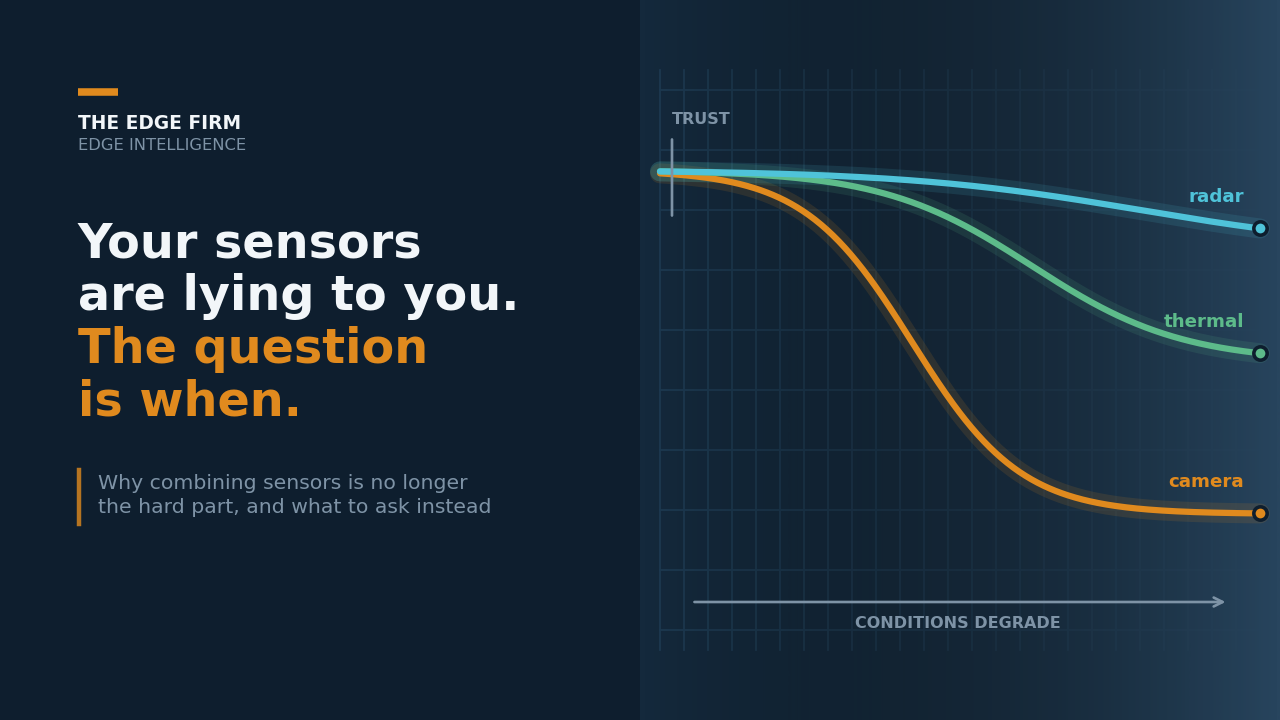
A camera at a mine entrance sees perfectly at noon and poorly at dusk. Not blind at dusk. Poorly. It still returns detections, still reports confidence, still feeds the same pipeline it fed six hours earlier. Nothing in the system announces that its output is now worth less than it was.
This is the ordinary condition of every deployed multi-sensor installation, and almost everywhere it is handled by a number chosen once, during development, by an engineer estimating how much to trust each sensor. That number is then frozen for the life of the system.
It is a reasonable engineering decision. It is also the source of a surprising share of the false alarms, dropped tracks, and general operator distrust that afflict remote monitoring sites.
Fusion is not the differentiator anymore.
Walk any security or industrial trade show and count how many vendors say they do sensor fusion. Radar plus camera. Thermal plus radar. LiDAR plus everything. The claim is now close to universal, which means it no longer distinguishes anyone.
What almost nobody does is quantify how much each sensor should be trusted right now and prove that the quantity is correct.
The distinction matters more than it sounds. Combining sensors is straightforward when they agree. The hard case is when they disagree, and disagreement is exactly what happens when conditions degrade. Fog arrives. A lens fogs over. Dust settles on the housing. Sun angle changes. Now the camera and the radar are telling different stories, and the system has to decide which one to believe using trust values set months ago in an office.
“The hard case is when they disagree, and disagreement is exactly what happens when conditions degrade.”
Degradation is rarely a clean failure.
The industry's usual answer is a threshold. Below a certain quality score, drop the sensor. Above it, trust it fully.
Real sensors do not cooperate with this. They degrade gradually and asymmetrically. A camera at dusk is not a failure, it is worse at range and fine up close. Radar in clutter does not fail, it is confident about some returns and not others. A threshold forces a continuous problem into a binary answer and produces a symptom operators know well: the estimate jumps the moment the threshold trips. Nothing physical changed. The system's opinion changed, discontinuously.
Anyone who has watched a track lurch sideways as a sensor was cut out has seen this. It teaches operators to distrust the system, which is a worse outcome than the original error.
Confidence is not uncertainty.
Nearly every perception system outputs a confidence score. Very few output a calibrated uncertainty, and the two are easily confused.
A confidence score is a number between zero and one that correlates loosely with correctness. A calibrated uncertainty makes a testable claim: the true position lies within this ellipse ninety five percent of the time. The second can be checked against reality. The first cannot.
This is not academic. If a system tells an operator that an object is at a location within ±0.5 m, that claim is either true at the stated rate or it is not, and it is measurable either way. Systems that report calibrated uncertainty can be held to account. Systems that report confidence scores cannot, which is precisely why confidence scores are more popular.
The practical consequence appears in alarm handling. An alert accompanied by honest uncertainty and a record of which sensors contributed is one that an operator can triage. An alert accompanied by 0.87 is one that an operator learns to ignore.
“An alert accompanied by 0.87 is one that an operator learns to ignore.”
Why does this become urgent at the edge?
None of the above would matter much if raw data could be shipped to a control center and sorted out there. At remote sites, it cannot.
A modest multi-sensor installation generates tens of megabits per second of compressed video, point clouds, and radar returns. The connectivity available at a mine, an offshore platform, a pipeline station, or a substation is frequently a small fraction of that, sometimes intermittent, and usually metered. Continuous raw streaming is not an engineering preference. It is often not an option.
So, processing moves to the edge, and what crosses the link becomes a compact description of what was observed rather than the observation itself. That description is worth a tiny fraction of the raw bandwidth, which is the obvious win.
The less obvious point is that compression makes trustworthiness non negotiable. When a control center received raw video, an operator could look at the picture and judge for themselves. When it receives a list of object states, it has no independent check. The only remaining basis for judgment is the uncertainty and provenance attached to each reported object.
Compact reporting and honest uncertainty are not two separate features. The first is only safe because of the second.
The direction of travel here is not toward systems that combine more sensors. It is toward systems that know, moment to moment, which of their sensors deserve to be believed, and that are willing to say so in a form you can check.
Keep exploring
Browse all reports →The next field report is in progress.
New reports publish periodically as they're finished.
The next field report is in progress.
New reports publish periodically as they're finished.