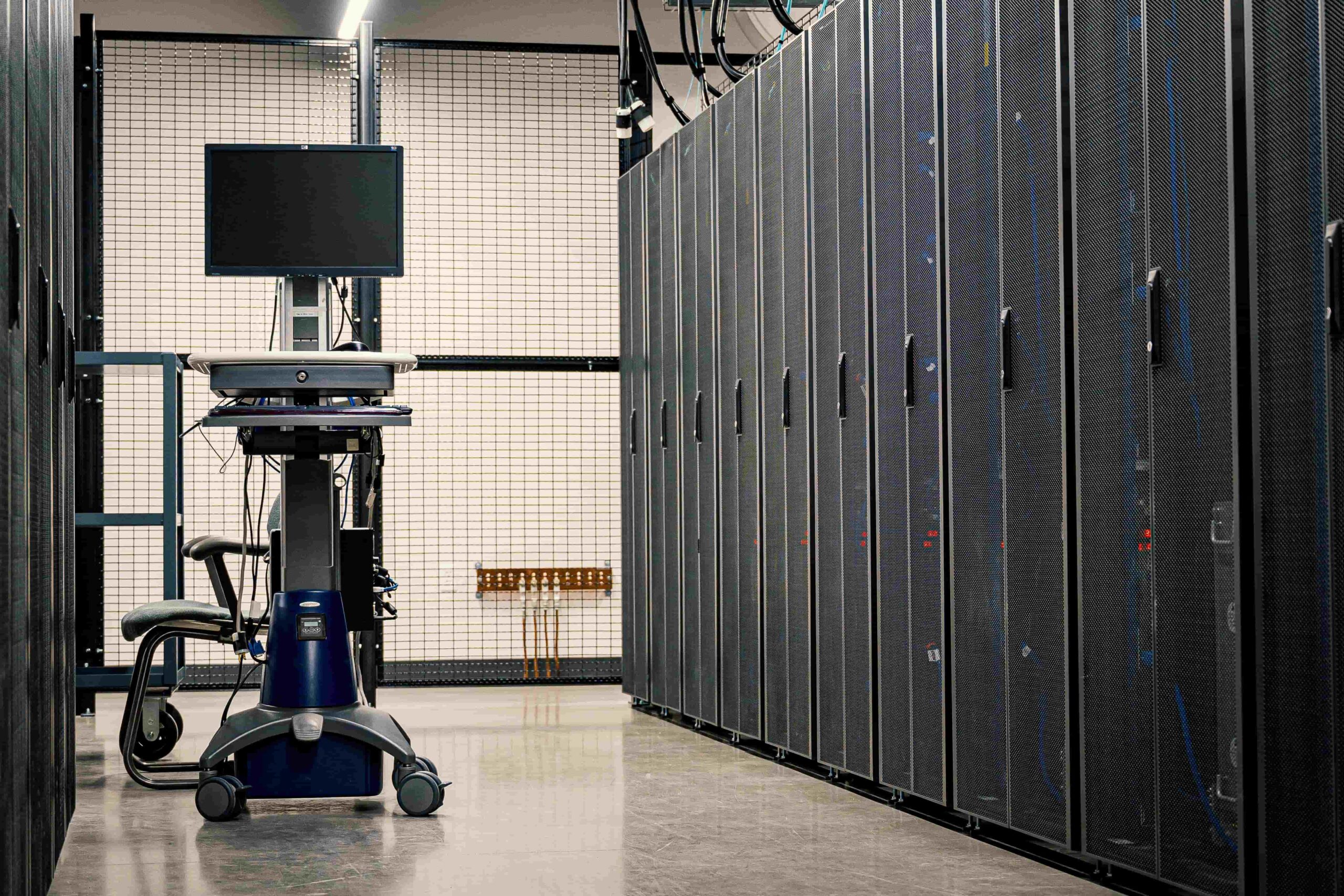
AI native design for 6G.
Co-designing communication, control, and computing.

Treat AI as a design responsibility
Machine learning can improve an existing network through traffic prediction, anomaly detection, or parameter tuning. Those improvements are valuable. A deeper architectural role emerges when the system must explicitly manage model compatibility, inference deadlines, training data, uncertainty, and updates as part of normal operation.
The IMT-2030 framework identifies AI and communication among its usage scenarios and discusses AI-enabled capabilities. It provides a direction for research and development, not a prescription for one particular combination of capabilities. Claims about AI-native design should distinguish broad ambitions from implemented functions and measured results.
Transmit information that serves the task
What information does the receiver actually need? For an industrial inspection task, the destination may need a defect decision or useful visual features rather than a full image reconstructed for human viewing. Task-aware communication can shape the transmitted representation to align with that objective.
This does not remove bits or reliability from communication. It changes what is encoded and how success is measured. Features that are sufficient for one inference task may omit evidence needed for another task, later analysis, or human review.
Joint source-channel coding is one relevant approach. Learned coding can jointly optimize an encoder and decoder across a channel model, and research has demonstrated graceful degradation of image quality under specified channel conditions. A result against one fixed-rate pipeline should not be generalized into a claim that learned transmission always avoids failure.
“Switching AI off is, therefore, an incomplete test. A stronger test asks whether the architecture explicitly supports the model lifecycle and defines what happens when a model is unavailable or unreliable.”
Measure the full radio and compute cost
A smaller transmitted representation may reduce radio usage while adding encoding, decoding, inference, and model management work. Measure total energy and end-to-end latency at comparable task quality, rather than treating fewer transmitted bytes as sufficient evidence of savings.
The crossover depends on hardware, model size, radio conditions, workload rate, and accelerator utilization. Lightweight models may be attractive in some settings, heavier models can erase the savings.
Use the twin to evaluate candidate actions
A digital twin may combine channel, traffic, mobility, and control models to estimate the effect of a candidate action before it is applied. A scheduling policy or resource adjustment can then be evaluated against defined operational objectives, with live telemetry supporting calibration and state updates.
The value of this process depends on decision-relevant fidelity. A twin can reproduce average throughput while missing short interference bursts or mobility transitions that determine whether a policy works.
Check drift before trusting predictions
A twin fitted to one environment can become unreliable when traffic, propagation, interference, or topology changes. Evaluation should include genuinely different operating conditions and clearly identify the domain over which the twin is trusted.
Increasing mismatch should trigger reassessment, recalibration, restricted use, or fallback. A more detailed twin is not automatically better if synchronization and execution consume the time available for a decision.
Place inference according to the whole deadline
Some inference belongs near the radio or device, other functions can run at an edge site or centrally. Placement should follow the complete path from measurement collection to action, including transport, queuing, preprocessing, inference, and actuation.
O-RAN provides useful integration points: near-RT RIC applications can interact with supported RAN functions through E2, while non-RT RIC functions support longer-horizon optimization and policy guidance. This does not place every beamforming or scheduling operation inside an xApp.
Validate sustained performance on edge hardware
Short accelerator benchmarks do not establish sustained performance. Memory pressure, concurrent workloads, power limits, and thermal throttling can change inference latency. Test the deployed precision and runtime, including preprocessing and data transfers, on the target hardware.
Re-evaluate task quality after quantization. Measure tail latency and missed deadlines alongside average throughput, and evaluate shared acceleration under realistic concurrent load.
Coordinate the model lifecycle across components
A task-aware encoder and its receiver need compatible representations. A twin needs a known calibration state. An edge model needs an executable artifact that matches its runtime and resource budget. Updating any one of these can alter the behavior of the others.
Record model versions, compatible configurations, validation conditions, and activation criteria. Stage updates so their effects can be observed before wider use, and design fallback with the learned path in mind.
Evaluate the complete operating loop
For a task-aware industrial vision service, measure whether the receiver reaches the required decision quality within its deadline, then account for all relevant communication and computation. A representation that saves bandwidth but increases missed defects or decision delay may be unsuitable.
Finally, run the integrated system on real hardware under sustained load and changing conditions. Report simulation, testbed, and field evidence separately, a strong simulation result establishes a different claim from reliable operation on a deployed network.
An AI-native proposal should identify its learned decisions, communication and compute costs, update dependencies, and operating limits. Its value rests on measured task quality, robustness, and recoverability. Semantic methods, twins, and edge inference are candidate building blocks whose integration must earn its place.
- ITU-R, Recommendation M.2160-0, IMT-2030 framework: https://www.itu.int/rec/R-REC-M.2160-0-202311-I/en
- Bourtsoulatze, Kurka and Gündüz, Deep Joint Source-Channel Coding for Wireless Image Transmission: https://arxiv.org/abs/1809.01733
- O-RAN Software Community, Architecture Overview: https://docs.o-ran-sc.org/en/latest/architecture/architecture.html