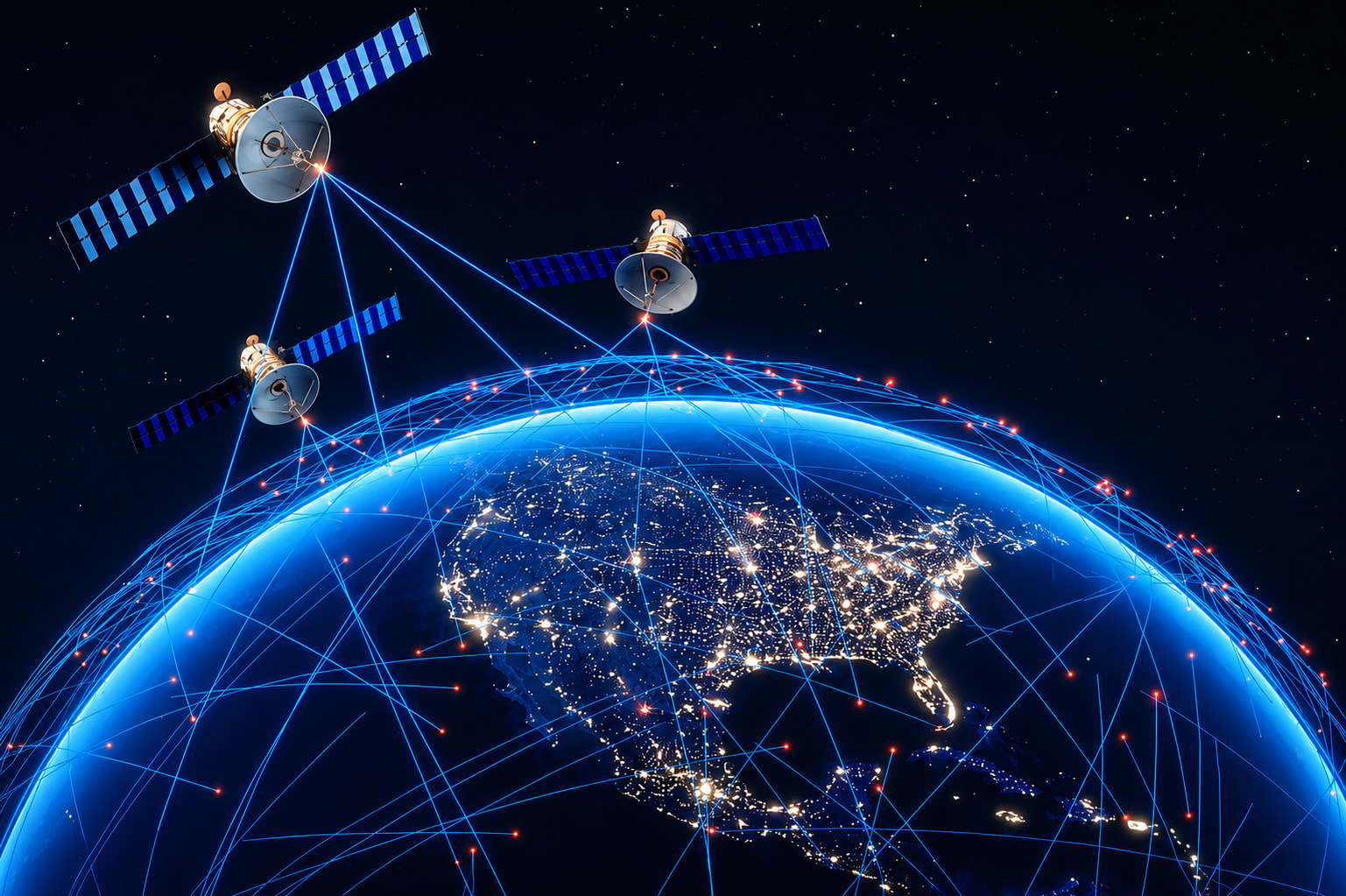
AI, multi-orbit networks and the road to 6G.
How software-defined satellites and intelligent orchestration could create a global connectivity fabric.

The future is multi-orbit and multi-band
LEO has transformed the satellite conversation because it can reduce propagation delay and support large global constellations. But no single orbit is optimal for every service. LEO offers lower delay and dense spatial reuse, MEO provides a balance between footprint and latency, GEO provides persistent visibility and wide-area coverage that remains attractive for broadcast and high-capacity services.
The more capable future network will use these differences rather than force every application into one architecture. A latency-sensitive service may prefer terrestrial or LEO access. A wide-area multicast service may benefit from GEO. A maritime platform may move among coastal terrestrial coverage and several satellite systems while its application session remains intact.
That is why orchestration becomes central. The network must choose paths based on latency, capacity, resilience, cost, spectrum allocation, service priority, regulation and application requirements, and then change those paths without breaking the service.
Optical inter-satellite links turn constellations into transport networks
Inter-satellite links change the role of a constellation. Instead of sending every packet down to a ground gateway before it can travel elsewhere, optical links allow high-data-rate traffic to move through the constellation itself.
This can reduce dependence on ground gateways, improve routing flexibility over oceans and remote regions, and make the constellation part of the transport network rather than simply a set of access points. In effect, the space segment begins to resemble a moving, distributed backbone.
Satellites are becoming software-defined network nodes
Traditional communications satellites were often optimized around relatively fixed payload architectures. Beam footprints, capacity and spectrum resources were strongly constrained by hardware configuration. Digital payloads are loosening those constraints.
Beam footprints can be reconfigured, capacity can be reassigned geographically, spectrum can be managed dynamically and selected processing can move onboard. Regenerative architectures, digital beamforming and onboard processing make the satellite look less like a fixed repeater and more like a programmable node in a distributed network.
AI moves from analytics into operations
A converged terrestrial and non-terrestrial network is a massive optimization problem: moving satellites, millions of users, changing beams, constrained spectrum, multiple gateways, inter-satellite routes, terrestrial coverage islands and fluctuating traffic demand.
That creates practical AI opportunities in traffic prediction, beam scheduling, spectrum optimization, predictive handover, anomaly detection, satellite health monitoring, gateway selection, energy management, dynamic routing and policy-based resource allocation.
“If 5G brought satellites into the cellular standards framework, 6G may make terrestrial and non-terrestrial connectivity feel like one intelligent network.”
The ground segment is becoming cloud-native too
The transformation is not limited to orbit. Ground infrastructure is adopting virtualization, containers, software-defined networking, distributed edge processing, APIs and automated orchestration.
Over time, satellite operators start to look less like isolated infrastructure providers and more like participants in a software-defined telecom and cloud ecosystem.
5G is the bridge, 6G could make convergence native
5G NTN provides the standards and architectural starting point for integrating satellite access with cellular networks. 6G is expected to push the concept further by treating ubiquitous connectivity, AI integration and multi-dimensional sensing as foundational design considerations.
The ITU IMT-2030 framework includes Ubiquitous Connectivity, Artificial Intelligence and Communication, and Integrated Sensing and Communication among its usage scenarios. Those themes map naturally to hybrid terrestrial and non-terrestrial systems in which communication, sensing and intelligent resource management are coordinated across several layers.
Security and standards become part of the architecture
Hybrid networks expand the trust boundary across space, ground, cloud, edge and multiple operators. Long infrastructure lifecycles also make quantum-safe migration increasingly relevant. Satellite Quantum Key Distribution can provide high-assurance key distribution over long distances, and should be treated as a complementary security layer rather than a replacement for end-to-end cryptographic controls.
Standards are equally strategic. As networks become more interoperable, organizations that shape protocols, interfaces, spectrum rules and orchestration frameworks can influence the market even if they do not own every spacecraft, terminal or launch vehicle.
The next satellite communications era will be defined less by a single constellation and more by the intelligence connecting many systems together. Multi-orbit networking provides diverse physical paths. Optical links create transport networks in space. Software-defined payloads make capacity programmable. Cloud-native infrastructure makes the ground segment more flexible. AI helps operate the whole system dynamically.
- ITU , IMT-2030: Technical requirements for the 6G future
- ITU-R , Report M.2569-0 (2026): Development and technology trends for the satellite component of IMT towards 2030 and beyond
- ESA , 6G Non-Terrestrial Networks: Reimagining the Global Connectivity Fabric
- ESA , EuroQCI / QKDSat / EAGLE-1 materials on satellite quantum-secure communications
- 3GPP , Release 19 NR-NTN Phase 3 material