
From separate worlds to a unified network.
How 3GPP NTN brings space into 5G.
How 3GPP Non-Terrestrial Networks are pulling satellites into the same architectural conversation as 5G, and eventually 6G.
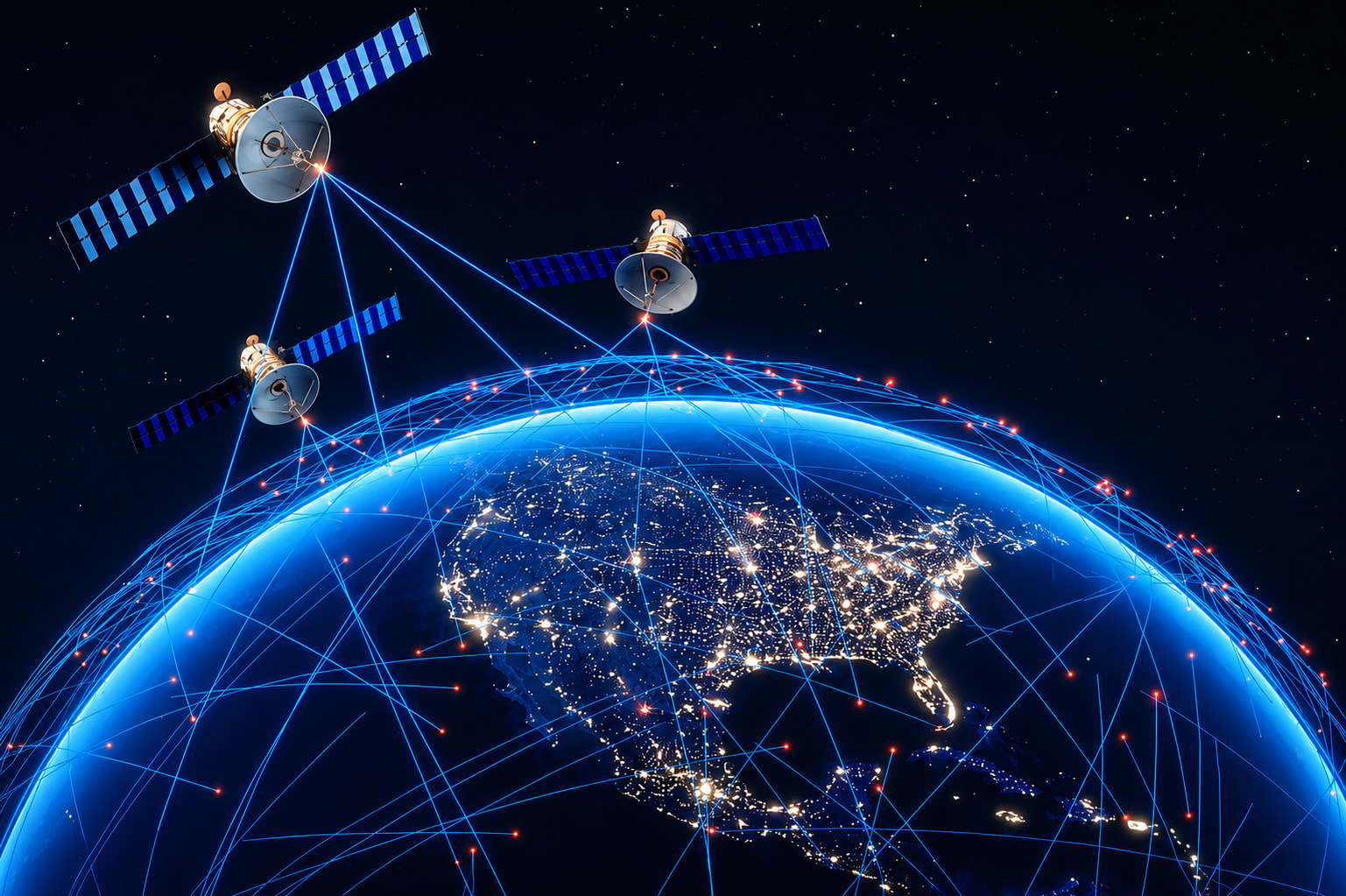
The boundary between space and telecom is disappearing
Historically, satellite operators built specialized spacecraft, proprietary ground systems, dedicated terminals and service-specific waveforms. Mobile operators followed a different path, centered on standardized handsets, radio access networks, licensed spectrum and increasingly sophisticated core networks. Each ecosystem optimized for its own economics and engineering constraints.
That separation is weakening. Low Earth Orbit constellations, standardized NTN, software-defined payloads, cloud infrastructure and new device capabilities are making satellites less like isolated systems above the telecom network and more like another access and transport layer within a broader communications architecture.
Why 3GPP NTN changes the architecture
The most important enabler of this convergence is standardization. 3GPP NTN work brings satellite access into the cellular standards family, including NR-based satellite access and LTE-based IoT connectivity. The standards account for characteristics that are fundamentally different from terrestrial mobile networks, such as long and variable propagation delays, high Doppler, satellite motion and very large coverage footprints.
A useful mental model is the “cell in the sky.” A LEO satellite is not literally a terrestrial base station: the timing, geometry, link budget and mobility environment are very different. But the architectural shift is important. Satellite access can increasingly participate in familiar mobile-network procedures rather than requiring a completely separate communications universe.
This changes the economics of integration. Mobile network operators can extend coverage with fewer bespoke interfaces, device makers gain a larger interoperable ecosystem, and satellite operators can connect into established core-network, identity, policy and service frameworks.
“The long-term architecture is therefore not simply ‘satellite versus terrestrial.’ It is a network in which terrestrial cells, LEO, MEO and GEO satellites, airborne platforms, edge computing and cloud infrastructure can be selected and coordinated according to service needs.”
A network made of multiple layers
LEO receives much of the attention because it offers lower propagation delay than GEO and can support extensive global coverage. But the future connectivity fabric is unlikely to be LEO only. Different orbital regimes offer different advantages.
LEO can support lower delay, dense spatial reuse and rapidly evolving constellation architectures. MEO can provide a middle ground between footprint, latency and infrastructure scale. GEO remains powerful for persistent visibility, wide-area broadcast and high-capacity coverage. Terrestrial 5G and private networks provide the dense local capacity that satellites cannot economically reproduce everywhere.
The more interesting architecture is therefore LEO plus MEO plus GEO plus terrestrial access. A converged core and orchestration layer can eventually choose among these resources according to latency, capacity, resilience, spectrum, policy, cost and application requirements.
Interoperability becomes a strategic issue
As satellites become standardized components of a larger telecom ecosystem, interfaces become strategically important. Standards influence how satellites interact with handsets, terrestrial networks, IoT devices, gateways and future orbital systems.
That makes standardization more than an engineering exercise. It can shape market access, device ecosystems and the balance of power among satellite operators, chipset vendors, mobile carriers, regulators and cloud providers. Competitive advantage can shift from owning every layer of the stack toward controlling orchestration, APIs, cybersecurity, quality of service, service continuity and network intelligence.
The engineering constraints do not disappear
Standardization does not remove the physics. Propagation delay remains important, particularly at higher orbits. LEO systems must manage significant Doppler and timing effects. Handover is unusual because the serving “cell” itself may be moving. Direct satellite links to compact devices operate under tight transmit-power and antenna constraints, while rain attenuation can erode link margin at higher frequencies.
Capacity is another important caveat. Global coverage does not mean terrestrial-like capacity density everywhere. A dense urban cellular network can reuse spectrum across thousands of small cells, a satellite beam may cover hundreds or thousands of square kilometres. Satellite and terrestrial systems are therefore most powerful when they complement one another rather than compete to do the same job everywhere.
What 5G NTN really changes
The deeper impact of NTN is architectural. It moves satellite connectivity from the edge of the telecom ecosystem toward its center. The satellite becomes less of a separate service destination and more of an additional path that a network can use when terrestrial access is unavailable, uneconomic or insufficiently resilient.
That foundation sets up the next step: ordinary phones, vehicles and IoT devices using satellite connectivity more naturally when terrestrial coverage ends. That direct-to-device shift is the subject of the next report in this series.
5G NTN is not the end state, it is the bridge. Its importance lies in creating common procedures and interfaces that allow space and terrestrial communications to participate in one larger network architecture. The long-term success of this transition may be measured by how invisible it becomes to the user: the application keeps working, while the network decides whether the best path is on the ground or hundreds of kilometres above it.
- 3GPP , 3GPP Highlights: global standard for satellite networks
- 3GPP , TR 38.863: NTN-related RF and coexistence aspects
- 3GPP , Release 19 NR-NTN Phase 3 material
- ITU , IMT towards 2030 and beyond (IMT-2030)