Direct-to-device: a new era for global access.
Why ordinary phones, vehicles and IoT devices are becoming part of the satellite ecosystem.

From specialized terminals to ordinary devices
Traditional satellite communications depend on purpose-built equipment: satellite phones, VSAT terminals, electronically steered antennas, maritime terminals or dedicated satellite IoT devices. That hardware is effective, but it creates a clear boundary between a “satellite user” and an ordinary mobile user.
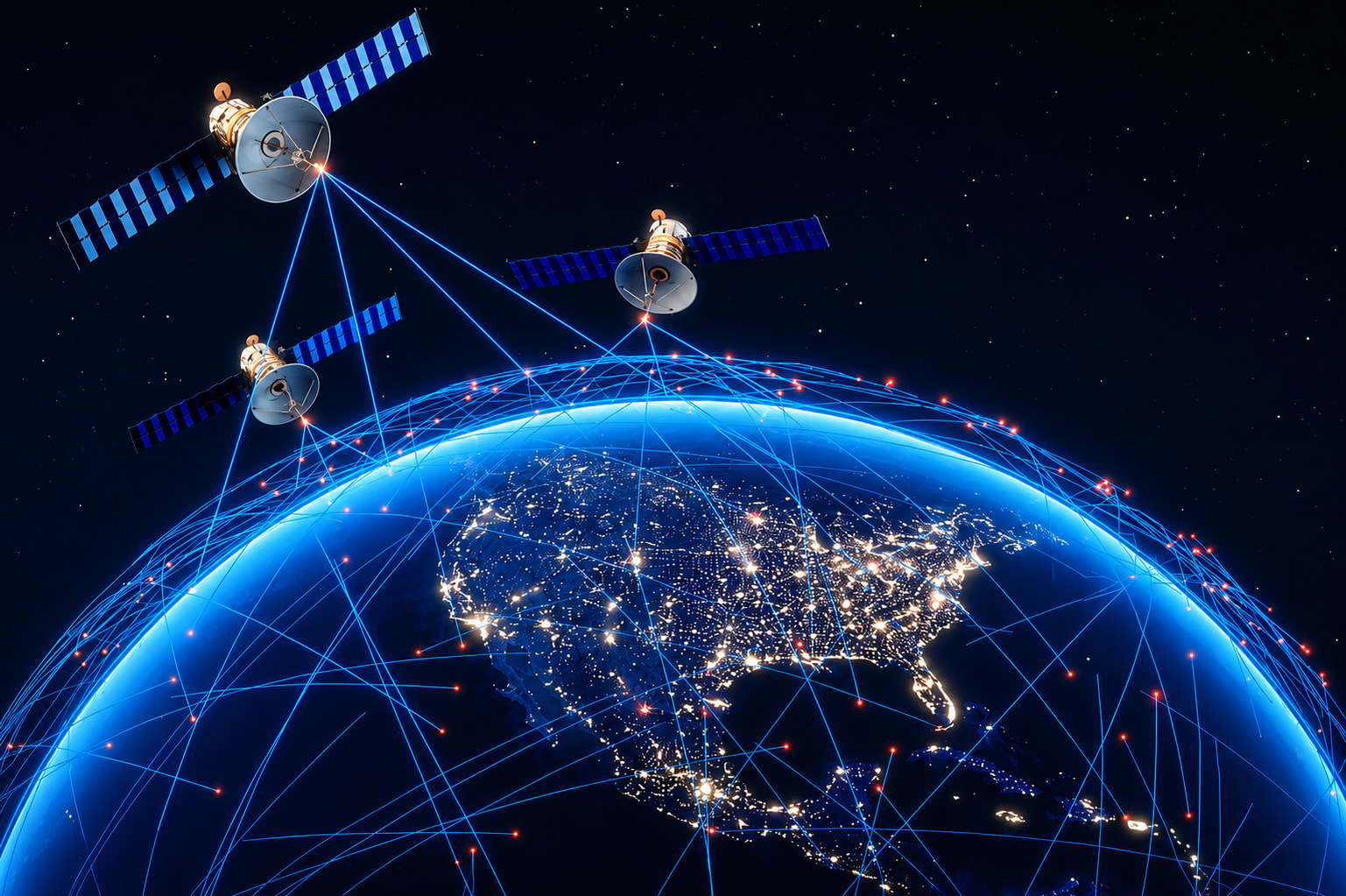
Direct-to-device connectivity changes the boundary. A conventional mobile device may be able to maintain some level of service when terrestrial coverage disappears by using a satellite network. Emergency messaging is the obvious early use case, but the path can extend toward messaging, telemetry, selective data services and, as device and network capabilities improve, broader communications functions.
The business implication is significant. Satellite connectivity no longer has to be something a user purchases as a completely separate service. It can become a feature embedded within a wider mobile, automotive, enterprise or IoT offering.
Satellite complements terrestrial, it does not replace it
Direct-to-device should not be interpreted as a replacement for terrestrial cellular networks. The capacity models are fundamentally different. A dense city can contain thousands of terrestrial cells with aggressive frequency reuse. A satellite beam can cover a vastly larger area, which is excellent for reach but much harder for terrestrial-like capacity density.
The realistic model is complementary: terrestrial where terrestrial works, satellite where terrestrial coverage is unavailable, uneconomic or insufficiently resilient. That combination is particularly powerful in rural areas, on highways, at sea, in aviation corridors, during disasters and across remote industrial regions.
The hard problem is service continuity
Connecting a device to a satellite is only part of the challenge. The more difficult problem is preserving the service as the underlying access network changes.
Consider a connected vehicle crossing a continent. It may begin on terrestrial 5G, transition to LEO coverage in a rural region, move between beams or satellites, return to terrestrial infrastructure near another city and finally enter a private industrial network. From the application’s perspective, the ideal result is simple: nothing breaks.
Underneath that experience, the network must coordinate mobility, authentication, network selection, policy, routing, security, quality of service, slicing, edge resources and potentially application or session state. The future requirement is therefore not merely “find another link.” It is “choose the right network and preserve the service while changing access paths.”
“The best user experience may be the one in which the user barely notices the satellite transition at all.”
Where direct-to-device matters most
Consumer mobile is the most visible market, especially for emergency and coverage-extension services. But the same architecture can affect many sectors.
Beyond consumer mobile, direct-to-device can support vehicle telematics, global asset and fleet tracking, remote industrial assets, agriculture, beyond-line-of-sight UAV operations and resilient remote healthcare. These are use cases where coverage gaps often matter more than peak capacity.
The constraints are real
Direct-to-device must work within the limited transmit power and antenna capability of ordinary handsets. The satellite link budget is therefore unforgiving, especially compared with specialized terminals. Doppler, timing and handover also require procedures adapted to moving satellites and large cells.
Finally, coverage does not guarantee capacity. Service design must match the physical reality of the link. Early direct-to-device offerings are therefore likely to emphasize high-value, resilient functions rather than pretending a satellite beam can always reproduce dense terrestrial broadband.
A different satellite business model
Direct-to-device broadens the satellite addressable market from specialist users to potentially millions of ordinary devices. That encourages partnerships among satellite operators, mobile network operators, handset vendors, chipset providers and cloud platforms.
It also shifts competitive differentiation. Success may depend as much on roaming arrangements, policy, service continuity, APIs, identity, billing and network orchestration as on the spacecraft itself.
Direct-to-device is important because it changes who can use satellite connectivity and how naturally that connectivity fits into everyday services. The opportunity is not to make satellites replace terrestrial networks, it is to make the two systems cooperate. When that cooperation becomes seamless, the boundary between mobile coverage and satellite coverage starts to lose meaning.
- 3GPP , NTN standards and related specifications
- GSMA / ESA , Funding initiatives for AI, NTN, direct-to-device and 6G
- ITU-R , Development and technology trends for the satellite component of IMT towards 2030 and beyond
- ESA , 6G Non-Terrestrial Networks: Reimagining the Global Connectivity Fabric